
by DAVE LYNCH
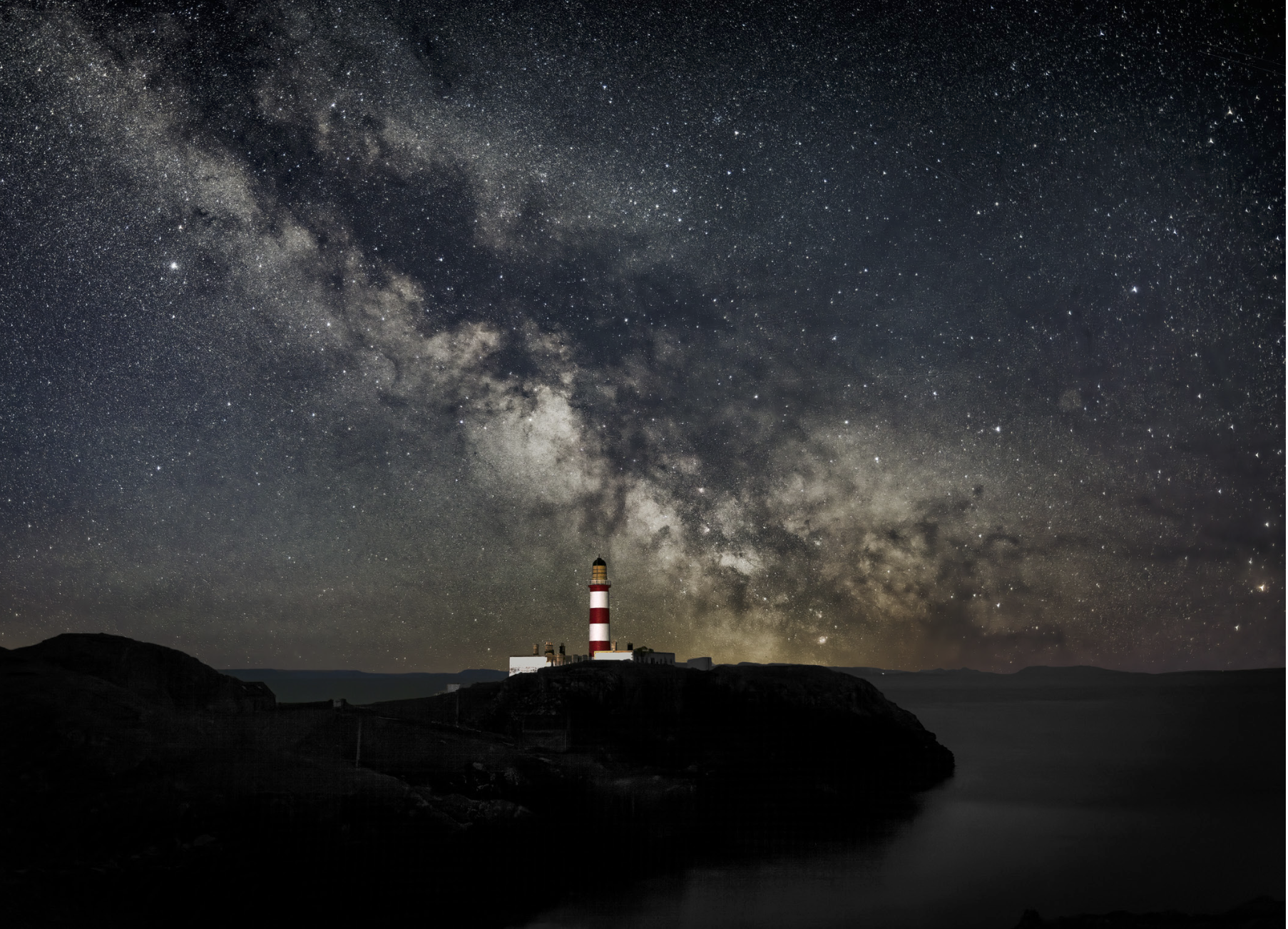
Eilean Glas Milky Way structure

The night skies have inspired mythologies, poets, lovers….and Dave Lynch. The beauty of landscape, night skies and the Milky Way can be captured with a modest equipment bag, but make sure to leave room for warm clothes.
I got into Astro landscape photography during lockdown.
At the time I was shooting with an Olympus M4/3 system and Olympus UK directed their staff, who would have otherwise been furloughed, to run a series of free online workshops three times a week. It was fantastic; they covered a whole range of topics, from learning about all aspects of the Olympus system menu to guidance on shooting genres from wideangle landscapes all the way down to macro.
It was a great support to Olympus photographers in those strange times. I found the astro-landscape talks really inspiring and that was that. I upgraded my camera body, bought a new lens and now I’m fixated on monitoring the skies for clear nights and the location of the moon and the Milky Way!
It’s been a steep learning curve. Landscape astrophotography obviously involves shooting in very low light conditions, and requires the photographer to consider how to optimally expose a scene with both the foreground and night sky in focus, whilst at the same time avoiding too much noise and/or creating star trails (unless of course you want to create them!). It’s a technical challenge which I really enjoy, and on top of that of course, you need to give some thought to creating an attractive composition with an interesting foreground subject.
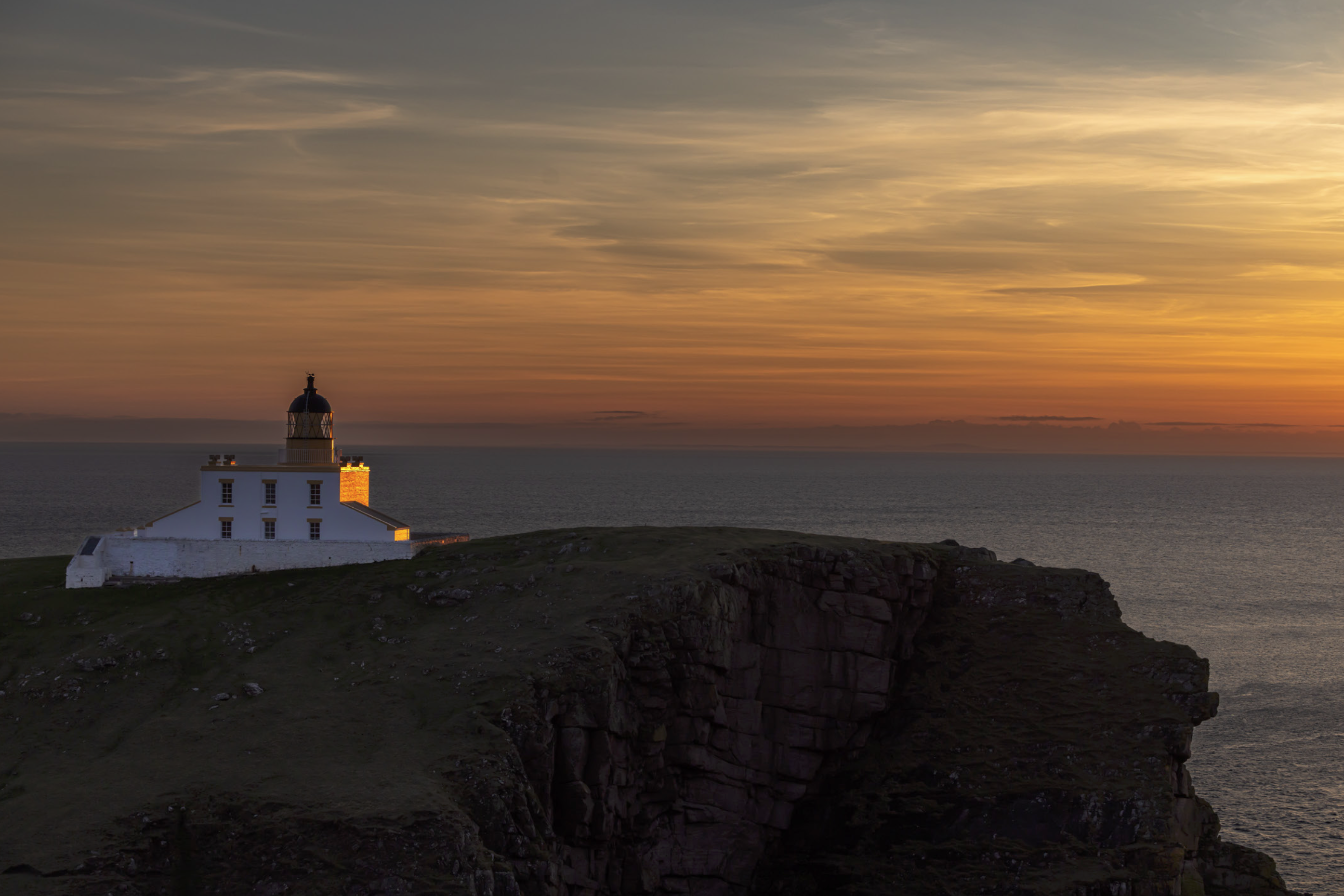
Stoer sunset
What we need to be able to do is capture as much light as possible, so a full frame camera is best, coupled with a fast wide-angle lens and stabilised on a tripod as the exposure times will always be
at least a few seconds long. I also occasionally use a star tracker which is a small, motorized mount that
sits between a camera and a tripod and rotates the camera synchronous with the rotation of the Earth. This prevents star trails that would otherwise be captured during long exposures. It means that you can have exposures of the night sky more than a couple of minutes. It can get very cold in the middle of the night so other important pieces of equipment are warm clothes!
One photographer I bumped into one winter night even had electric socks and an electric gilet. I was mightily jealous as I chittered away whilst peering through my view finder!
The position of the Milky Way moves throughout the year and also varies according to latitude.
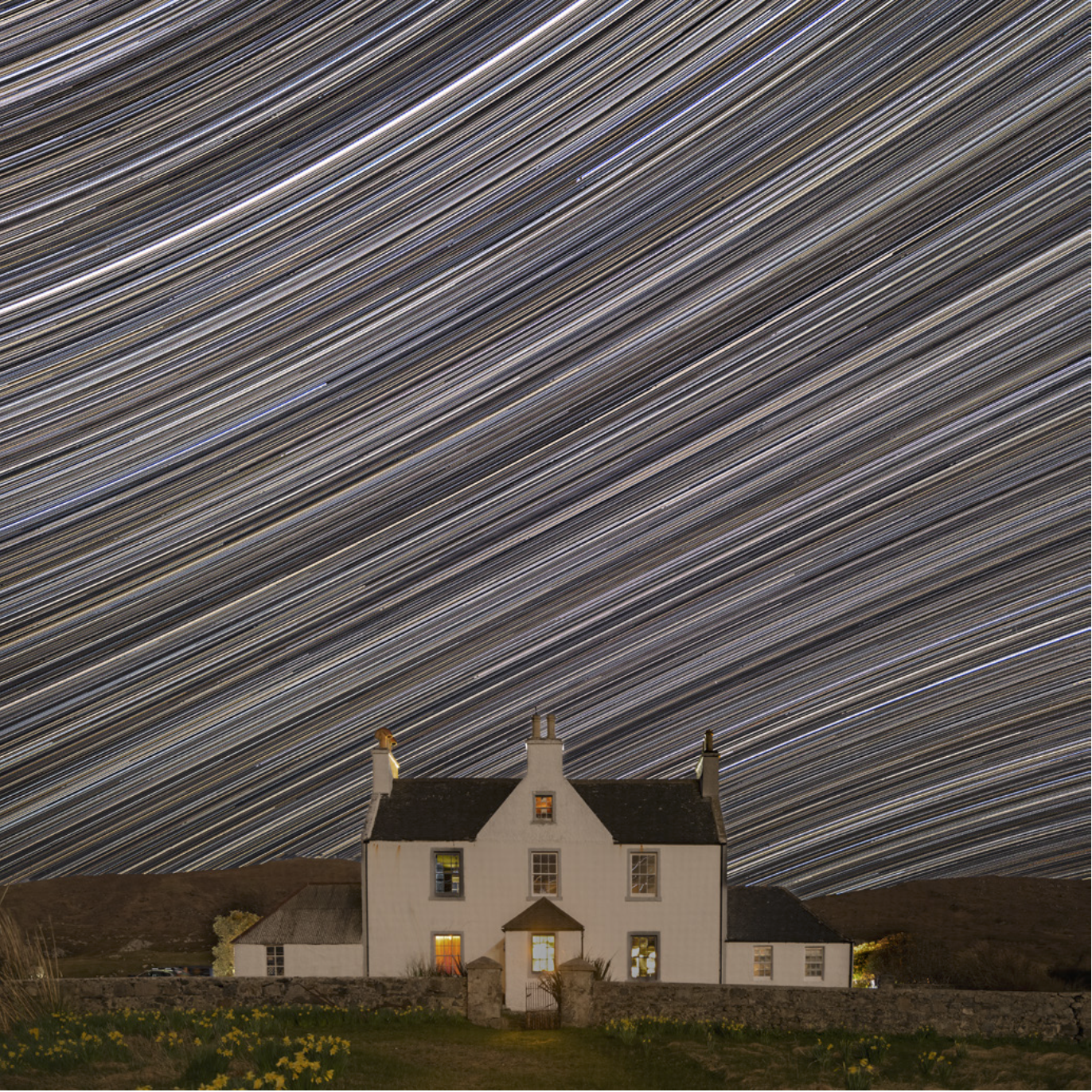
Scarista star trails
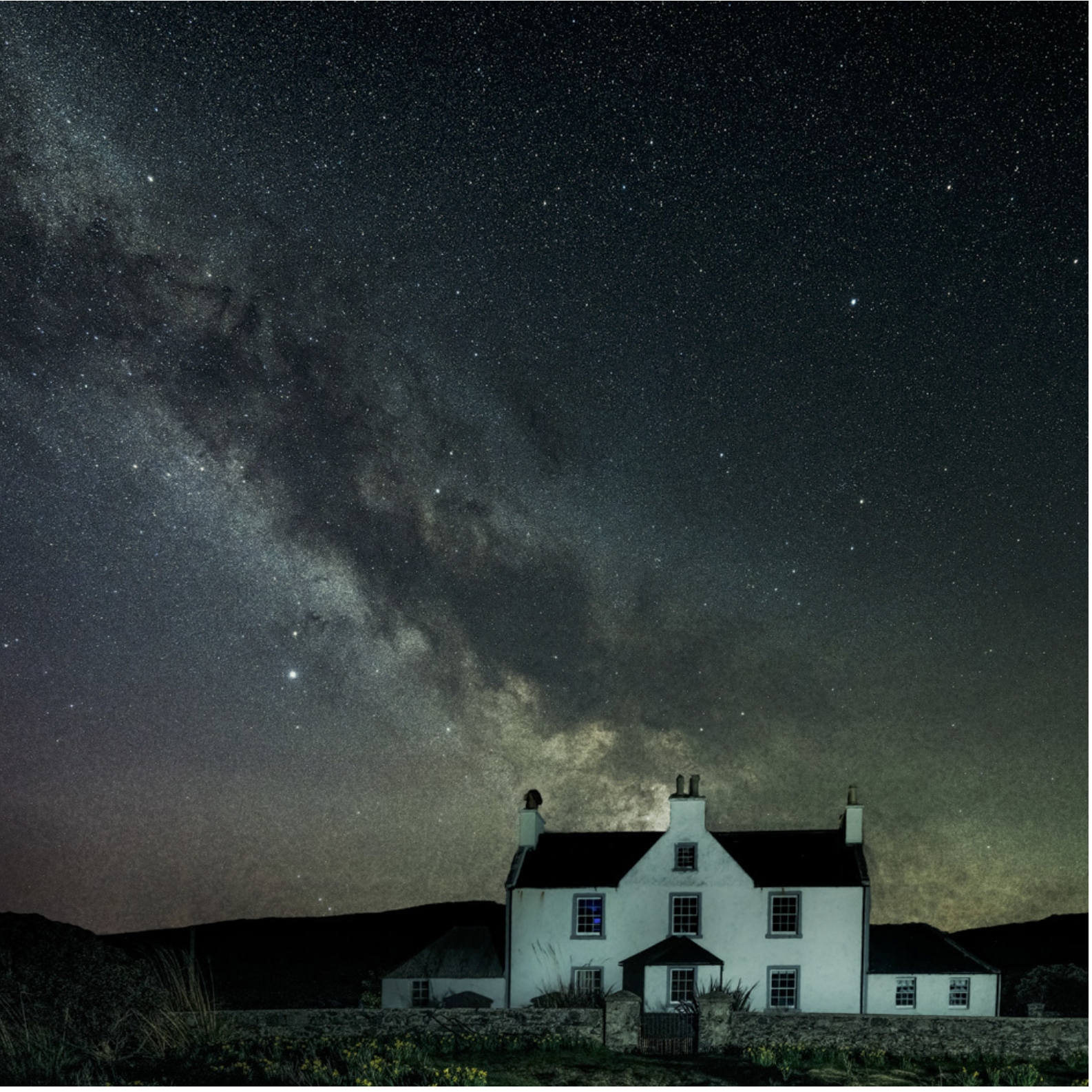
Scarista Milky Way
It’s critical to spend time planning shots in order to determine when the optimal juxtaposition of the Milky Way (or any other celestial object you want to shoot) will be relative to your subject, and also to know the phase and location of the moon which can either act as a light polluter or a useful illuminator. Fortunately, there are a few apps that can help with that; my favoured one is PhotoPills.
I live in Aberdeen which suffers from substantial light pollution. This limits what I can do from my house, so any opportunity to get into darker skies is always welcome. Fortunately, I can hop in a car and be in much darker skies west of the city within an hour. The only issue is that being so far north in the UK there is only a limited window to shoot the galactic core, the most interesting part of the Milky Way. It’s below the horizon for the winter months and only really gets above the horizon between April and September. However, due to the absence of real darkness during the summer, you really won’t be able to see the Milky Way during June and July so the shooting window is a bit limited for me. Plus, of course, Scottish weather doesn’t always cooperate to provide cloudless night skies!
Back in March this year I travelled to the Isle of Harris with my wife, Gail, to celebrate her birthday. Photographers will likely be familiar with the stunning coastal landscapes in the Outer Hebrides
– like the perennially popular Luskentyre beach – but the island’s remoteness and very low population density also means it has minimal light pollution so it’s fabulous for capturing images of the night sky. Luckily for me, my wife’s birthday fell on a day when the moon was only 13% and with the light free skies amazingly clear of cloud, and a successful spousal negotiation, I was well set for a night of shooting the stars.
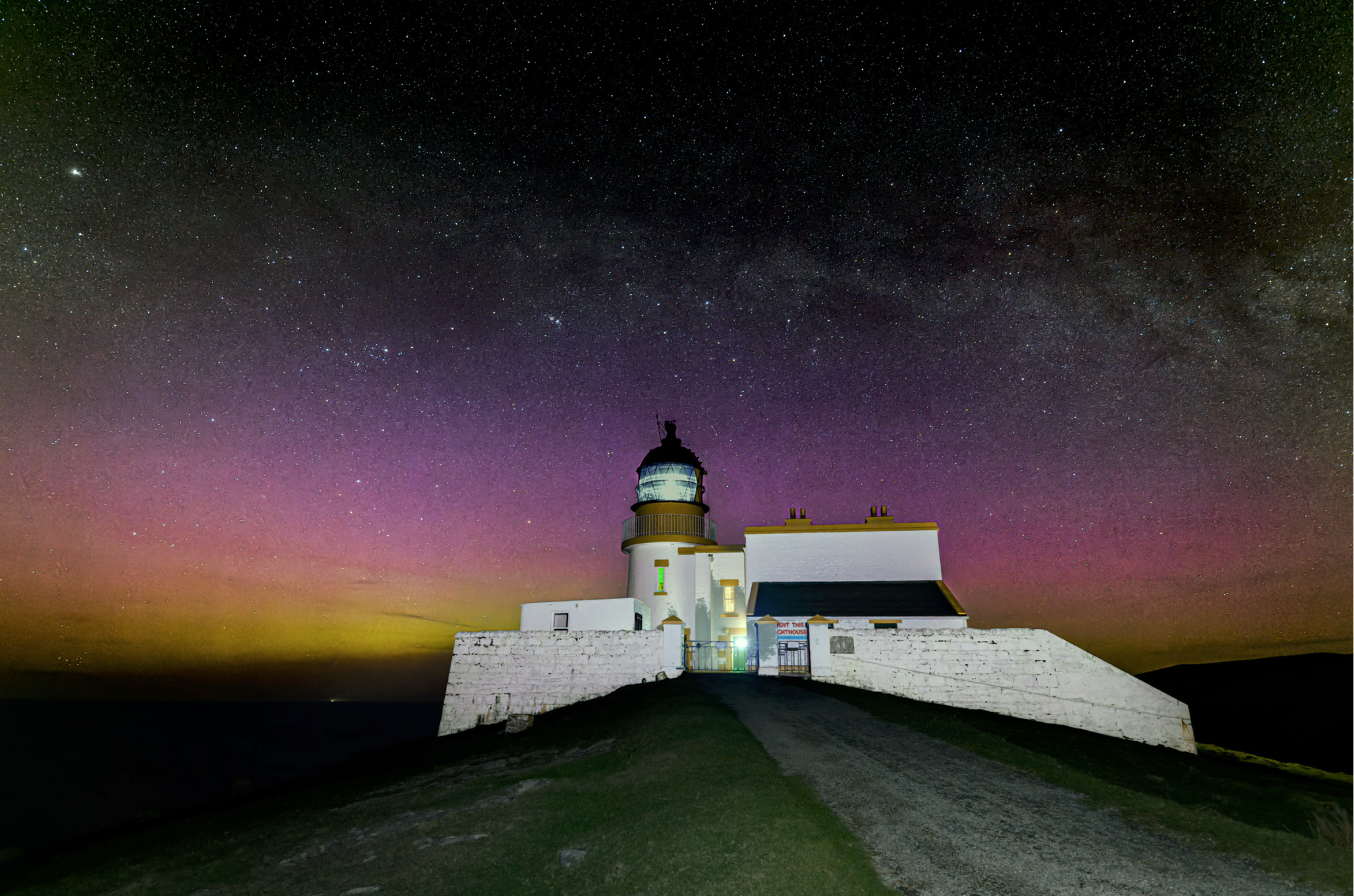
Stoer Milky Way
We were staying in the Scarista House, a hotel just above the spectacular Scarista beach. It’s a beautiful old manse and provides an interesting foreground to incorporate into a night sky shot.
I had two objectives in mind; one to construct a star trail image and the second to image the structure of the Milky Way. I set the camera up with an intervalometer – f/3.2, ISO 1600, 30 second exposure – pressed the shutter and went to bed for four hours! I gathered more than 500 images which I then stacked in post to create a composite star trail image. I also shot 20 frames specifically for the Milky Way structure – f/3.2, ISO 800, 10 seconds. The shorter exposure time minimises the risk of getting star trails. I then stacked them together using a programme called StarryLandscapeStacker which helps remove noise from the final image and helps resolve detail in our home galaxy.
While we were on Harris, we visited the Eilean Glas lighthouse on the adjoining island of Scalpay. The lighthouse is in a beautiful, somewhat remote setting and is very striking; a 30-metre tower painted with two distinctive broad red bands and with the beautiful Isle of Skye in the distance to the south. I’m fascinated by lighthouses, so much so that I bought the book The British Lighthouse Trail: A Regional Guide, by Sarah Kerr. It’s a veritable treatise on the lighthouses around the UK coast. Gail and I have been slowly ticking them off; a bit like a sedentary version of bagging the Munros. One thing I’ve been keen to do is shoot a lighthouse with the Milky Way as a backdrop, so our visit to Eilean Glas gave me an opportunity scout out a shot.
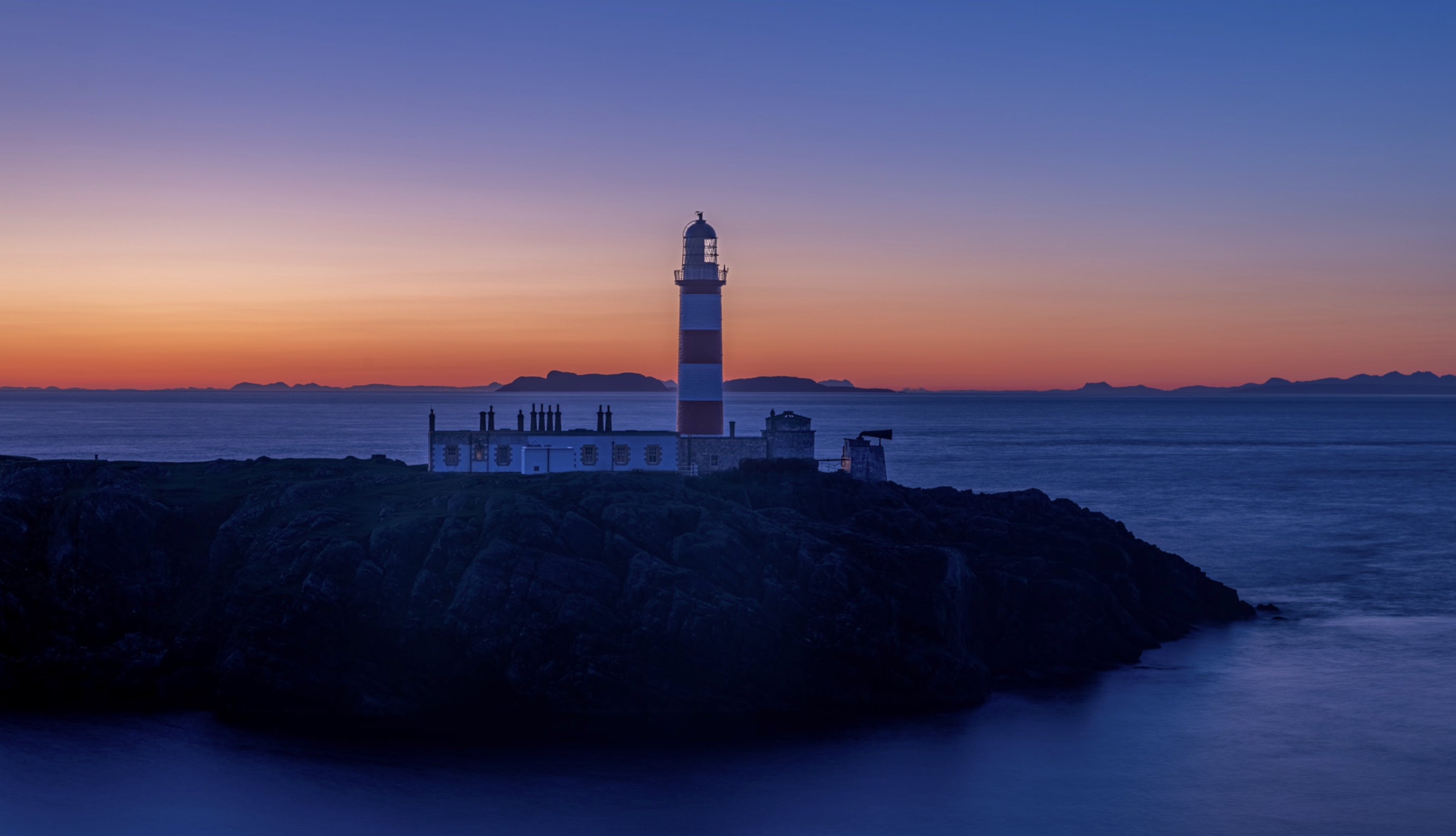
Eilean Glas Sunrise
Using the Augmented Reality feature in the PhotoPills app, it’s possible to view a composition through a camera phone and see the Milky Way superimposed on top. You can then adjust the time and date and watch the Milky
Way move through the sky until you see an optimal composition where the Milky Way lines up with your subject. I could see from the app that the Milky Way would be in an optimal position behind the lighthouse the following month on the 19th April at 0300 and, with a new moon, it would be ideal dark conditions. So, I hoped for clear skies and made plans to return for a night-time shoot.
Sure enough, one month later my crossed fingers seemed to have worked – a high pressure was forecast over Harris for a few days coinciding with the new moon!
So off I headed west to catch the ferry from Ullapool to Stornoway. Lighthouses are a little tricky to shoot due to the strength of the light beam, so I stopped off for a practice shoot at Stoer Lighthouse north of Ullapool the night before I caught the ferry. I arrived in time for an utterly spectacular sunset, and I was delighted to get some images of the lighthouse in a wonderful golden light before settling down to shoot in the dark …. and freezing conditions!
Lighthouses operate with a distinct lamp signature that allows sailors to identify the different lighthouses from the sea. The Stoer lighthouse signature is a white light with a single flash every 15 seconds. So, I set my camera with a 13 second exposure timing to avoid the intensity of the lighthouse beam and managed to get an acceptable image of a horizontal part of the Milky Way behind the lighthouse and with, rather unexpectedly, a mild Aurora Borealis to boot.
The lighthouse at Eilean Glas is a 2.5km walk from the road end which would have been fine other than I was carrying a full pack with my camping gear, camera equipment including star tracker and panoramic rig and as many warm clothes as I could squeeze into my rucksack. There is a bothy at the lighthouse that I was able to use which was perfect for setting up my base. I arrived mid-afternoon so had plenty time to scope out the best location for that evening and plan my approach to capturing the lighthouse and the core of the Milky Way. Once astronomical twilight ended at 2325, I set up my small LED panel just a few 10s of metres from the lighthouse to provide some foreground lighting, then placed my tripod around 250m away on the hillside overlooking the lighthouse, and waited for the Milky Way to get into position.
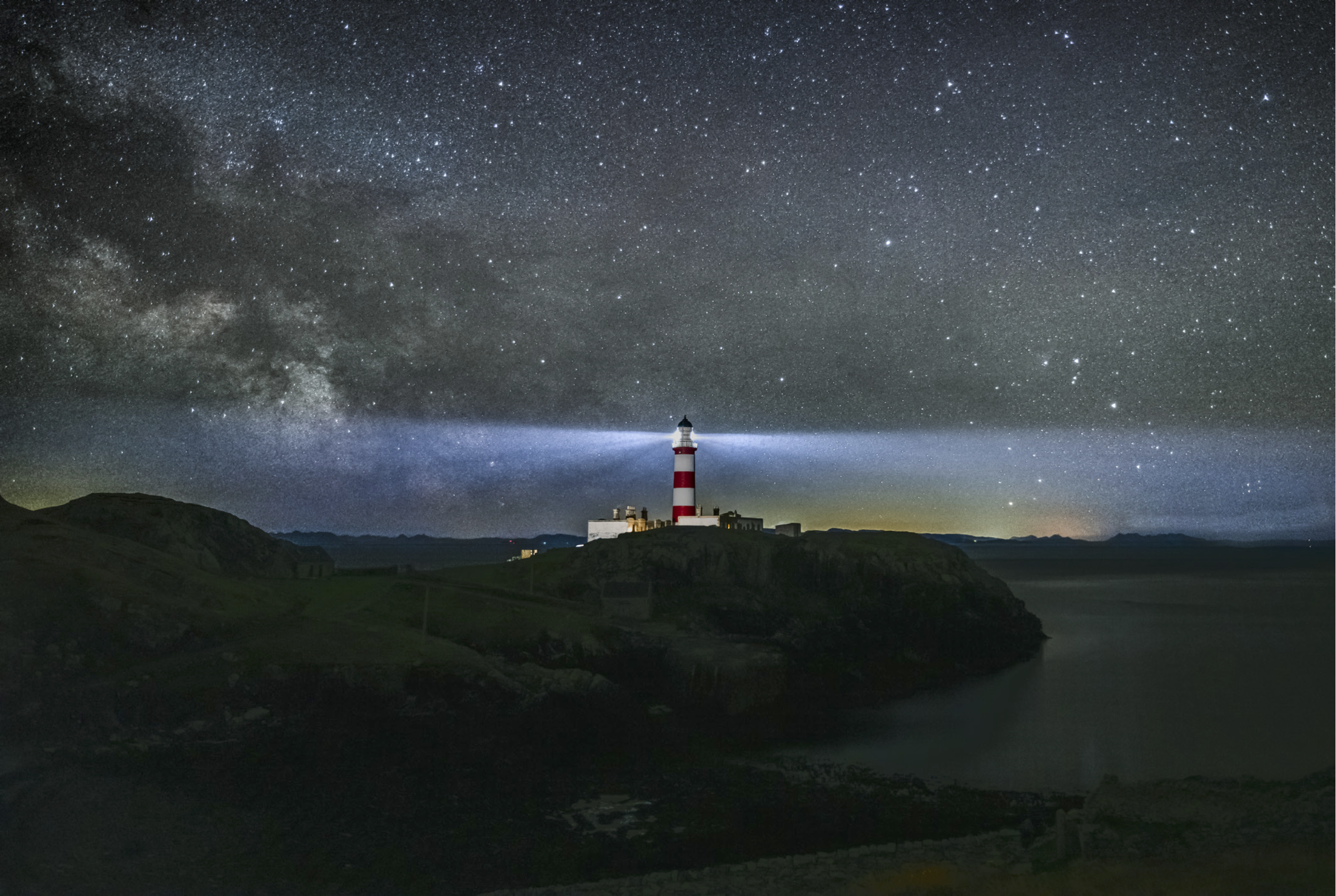
Eilean Glas lighthouse beam
The Eilean Glas lamp signature is three white flashes every 20 seconds and again I shot at 10 second exposures to minimise the risk of star trailing and to comfortably shoot in the gap between the flashes. As it turned out however, the lamp has a barrier installed to prevent the light illuminating the land, so I was protected from the main beam whilst shooting which enable me to capture some shots of the milky way with the beam of the lighthouse. I also shot with my star tracker, which allowed me to collect images with a two-minute exposure, at a low ISO of 400. With these settings and the very low levels of light pollution, it was possible to gather an image with lots of detail of the Milky Way structure. One complexity of using a star tracker is that the foreground gets blurred over the period of the exposure as the camera is tracking the movements of the stars. To manage this, I had to create a composite image, shooting a separate image of the sky and the lighthouse then blending them together during post-processing.
And of course, one of the added benefits of shooting through the night is that you are also already on location for the sunrise; so, no struggling to overcome the lure of a warm bed to get the best of early morning golden hour! Definitely a plus point of astro-landscape photography!
It’s a challenging but rewarding experience working to capture night-time images in remote locations, and there is something quite extraordinary doing it in complete silence and darkness.
I am still in learning mode; after each shoot I always try and draw out take-aways that I can build on to improve the shots for when the clouds clear again and I get to head out into the night with my new electric gilet!
You can find more of Dave’s work on Instagram at daveloslynch38.
 Visions Photography Club
Please leave a comment - we would love to hear from you.